Feng shui (pronounced fung-shway or fung-shooy) was created as an ancient Chinese system, a combination of geography and astronomy, which encourages use of aesthetics and architecture to enhance the quality of living.
Literally, “feng shui” means “wind and water”, reflecting its foundation in the flow of the invisible energy chi, which is affected by the five ancient elements earth, fire, metal, water, and wood. Chi’s effect can be positive or negative, and its behavior is influenced by matters such as age, climate, location, and shape.
The practice of feng shui, an ancient Chinese art and science, is centered on the thoughtful arrangement of objects and spaces in order to harmonize the flow of energy—known as chi (or qi)—throughout an environment. Practitioners believe that the strategic placement of furniture, decorations, and structural elements can help minimize negative chi that creates stagnation or imbalance, while at the same time encouraging the circulation of positive chi that fosters prosperity, health, and emotional well-being. A fundamental principle of feng shui is the pursuit of equilibrium between yin and yang, the complementary forces representing opposite but interconnected energies. Yang embodies brightness, activeness, and giving energy, whereas yin represents stillness, receptivity, and calm. Achieving harmony between these two ensures that the energy in a home or workspace supports both productivity and relaxation.
Another essential component of feng shui is the application of the Five Elements Theory—earth, fire, metal, water, and wood. Each element symbolizes a distinct type of energy and is linked to specific colors, shapes, textures, and materials. For instance, wood is associated with growth, vitality, and shades of green or brown; fire embodies passion and transformation, reflected through triangular shapes and warm hues like red or orange; earth provides stability and nourishment, represented by square forms and earthy tones such as yellow or beige; metal denotes precision and clarity, often expressed through round shapes and metallic colors like white, silver, or gold; and water symbolizes fluidity and abundance, connected to wavy patterns and deep blues or blacks.
These five elements do not exist in isolation—they interact according to specific productive and destructive cycles. For example, earth enhances metal by providing the minerals from which it is formed, while metal controls wood by cutting or shaping it. Conversely, in the destructive cycle, water extinguishes fire, and wood can deplete earth by drawing nutrients from it. Recognizing these interrelationships helps practitioners decide which elements to emphasize or moderate within a given space, ensuring that no single force dominates to the detriment of others.
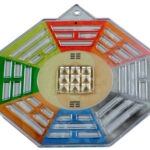
The five elements also correspond to the eight cardinal and intercardinal directions of the compass rose—north, northeast, east, southeast, south, southwest, west, and northwest. Each direction carries symbolic meanings and influences specific areas of life. For example, the north is typically associated with career and life path, governed by the water element, while the south connects to fame and reputation, ruled by fire. The east supports family and health, resonating with wood, whereas the center—though not one of the eight directions—represents grounding and balance, aligned with the earth element. By orienting rooms or decorative features according to these alignments, feng shui practitioners can enhance favorable aspects of life such as prosperity, relationships, and wellbeing.
Because these principles can be interpreted and applied in many ways, there exist numerous techniques, schools, and regional styles of feng shui. The Form School, one of the oldest, emphasizes the natural landscape and physical features surrounding a site, such as mountains and rivers, to guide placement decisions. The Compass School, in contrast, relies on precise directional readings and the use of the luopan (a traditional feng shui compass) to analyze energy flow. Modern adaptations also incorporate elements of psychology and interior design, blending ancient wisdom with contemporary aesthetics.
Altogether, the interaction of energy, direction, elements, and environmental design produces an intricate system of rules, remedies, and enhancements. Whether one practices feng shui to attract prosperity, build harmonious relationships, or simply achieve a calmer living space, it encourages mindfulness about the spaces we inhabit and the unseen energies that influence our daily lives.
Although it is preferable to apply feng shui when something is being created, such as when a building is being designed, there are also methods available to make corrections. For example, it is simpler to design and build a doorway in a desirable location, but if that was not done then correction is generally simpler than having carpenters move a doorway.
Tools for Fengshui
Natron for Bathrooms: Used in bathrooms this unique tool can balance the negative energy comes with a unique chamber for sea salt