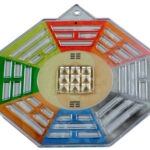
There are five basic forces or elements in feng shui.
The five elements—fire, earth, metal, water, and wood—form the foundation of an ancient system of thought central to Chinese philosophy, medicine, and cosmology. These elements, often referred to as the Wu Xing, are not simply physical substances but represent dynamic forces or phases that interact and transform into one another in a continuous, cyclical manner. Their relationships illustrate how natural phenomena, emotional states, and even social interactions evolve and balance over time.
Primary Feng Shui cycles
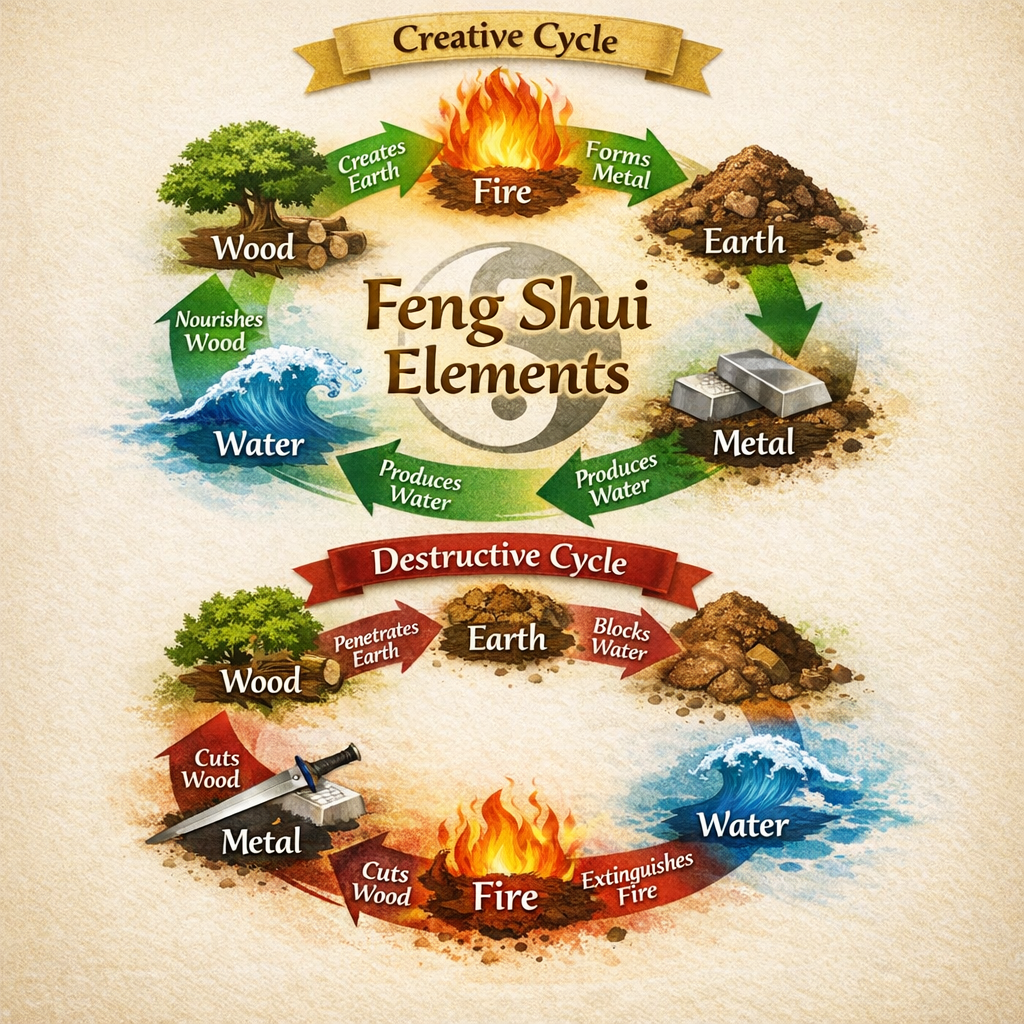
There are two primary cycles that govern the interaction between these five elements: the cycle of creation and the cycle of destruction. The constructive or generative cycle demonstrates how each element nurtures, supports, or gives rise to the next, creating a pattern of harmony and cooperation. In this sequence, fire burns brightly and leaves behind ash, which becomes earth. The earth, through its minerals and stability, gives birth to metal, which, when melted or transformed, generates water through condensation and purification. Water, the essence of life, nourishes wood, allowing plants and trees to grow. Finally, wood fuels fire, allowing the cycle to begin once again. This continuous transformation illustrates the interdependence of all things in nature and is a symbol of balance, growth, and renewal.
Conversely, the cycle of destruction, or controlling cycle, represents the dynamic of restraint and regulation, where each element limits the potential excess of another. While this interaction may seem negative, it is equally necessary for maintaining equilibrium. In this sequence, wood draws nourishment from and depletes earth, weakening it. Earth can absorb and block the flow of water, restricting its movement. Water, in turn, can extinguish fire, ending its brilliance. Fire melts metal, transforming its structure, and metal can cut or fell wood, bringing its growth to an end. This seemingly opposing cycle does not merely represent destruction but rather control—preventing any single force from becoming too dominant and ensuring that balance is preserved in a broader sense.
Together, these two cycles—the constructive and the destructive—illustrate the intricate harmony of the natural world. They symbolize how all aspects of life, from the physical environment to human emotions and relationships, follow patterns of creation, nourishment, and restriction. When these forces are balanced, they bring stability and growth; when they fall out of alignment, they lead to conflict and disharmony. The philosophy of the five elements, therefore, teaches that true harmony is not the absence of opposition but the dynamic equilibrium between complementary forces working in constant interaction.
Using knowledge of the five elements
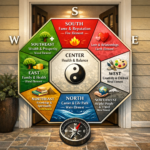
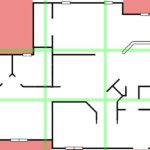
If you divide the house into nine equal parts (eight directions and the center), each part has been attributed to an element.
Wood
Fire
Earth
Wood
Earth
Metal
Earth
Water
Metal
When objects are arranged in a way that they complement and support each other within the constructive, or productive, cycle, the overall energy and balance of the space are naturally enhanced. According to traditional philosophies such as Feng Shui and the Five Elements theory, every element — wood, fire, earth, metal, and water — interacts with the others in distinct ways. When these interactions follow the constructive cycle, they nourish and strengthen each other, creating a harmonious environment filled with growth, vitality, and positive flow.
For instance, if an object that represents water — such as an aquarium, a decorative fountain, or even a painting featuring flowing water — is placed in the section representing wood, it serves to nourish and enhance the wood element. In the natural world, water sustains plants and trees, allowing them to thrive and grow tall and strong. Similarly, in an interior space, the presence of water in the wood sector encourages creativity, expansion, and prosperity. This thoughtful placement strengthens both elements, promoting a sense of vitality and continuous growth within the home or workspace.
However, when Feng Shui elements from the destructive or controlling cycle are positioned together, their energies can conflict and weaken each other. The destructive cycle describes how one element can suppress or diminish another — for example, metal cuts wood, fire melts metal, earth absorbs water, and so on. If metal objects, such as metallic wind chimes, stainless steel furniture, or large metal sculptures, are placed in the wood sector, the sharpness and rigidity of metal can undermine the nurturing essence of wood. This imbalance may lead to feelings of tension, stagnation, or conflict within the space, manifesting as restlessness, obstacles, or even strain in relationships or career growth.
To encourage harmony and positive energy, it is essential to mindfully arrange your surroundings in alignment with the constructive Feng Shui cycle. By adjusting the location of certain objects — perhaps moving metal décor away from the wood section and replacing it with water elements or natural wooden furnishings — you can shift the flow of energy and improve the atmosphere of your home. Small yet intentional changes, such as choosing the right colors, materials, and textures associated with each element, can make a remarkable difference.
Ultimately, harmonizing the five Feng Shui elements in your living or working area nurtures balance and well-being. It transforms your environment into a space that not only looks aesthetically pleasing but also radiates tranquility, empowerment, and prosperity. Through understanding these cycles and applying them carefully, you can create a living space that truly supports both your physical surroundings and your inner peace.
The qualities of the five elements
A shape is associated with each Feng Shui element, and each with qualities.
Fire
Shape: Triangle.
Qualities: Intelligence, spirit and life, wisdom, reason, etiquette.
Materials: Animal products, shiny fabrics, things generating light and heat.
Interiors: Kitchens, stoves, fire places.
Shapes: Pointed, slanted, sharp angled, buildings where animals are kept.