In feng shui, the Baguais one of the most essential and foundational tools used to understand and harmonize the flow of energy, or Qi, within a space. This intricate map serves as a symbolic representation of various aspects of life, showing how each direction in an environment corresponds to specific life areas such as wealth, health, relationships, career, and creativity. The Bagua is traditionally divided into eight sections, surrounding a central area that symbolizes balance, stability, and overall well-being. Each section is associated with a specific direction, element, color, and set of attributes that can help identify which parts of a home or workspace influence different aspects of an individual’s life.
Beyond being a simple diagram, the Bagua represents the journey of life and the path of the Tao—a reflection of the natural order and interconnectedness of all things. It helps practitioners recognize the subtle yet powerful relationship between people and their surroundings. By overlaying the Bagua map onto the floor plan of a house, room, or even an outdoor area, one can identify how energy flows through the space and determine which areas may need rebalancing or enhancement.
Through thoughtful arrangement, placement of furniture, and use of symbolic elements such as light, color, and natural materials, the principles of the Bagua can be applied to create living, working, and leisure spaces that are comfortable, inspiring, and energetically balanced. When used with intention, the Bagua not only improves the physical aesthetic of an environment but also nurtures emotional harmony, personal growth, and overall life satisfaction. Thus, it functions as a practical and spiritual guide toward achieving harmony between our inner world and the outer spaces we inhabit.
Bagua uses an eight sided diagram, with each side symbolizing an aspect of life such as family, children, health, friendship, love, travel, business and money. Rather than the Lo Chu squares, the Bagua diagram uses eight wedges extending out of a circular center. There are two types of Bagua diagrams: The Early Heaven is used outside to ward off bad chi, while Later Heaven is used inside. Early Heaven can be identified by having three unbroken lines at the top, and it usually has a reflector in the middle. The top represents South because ancient Chinese maps placed south at the top.
Bagua Map Technique
4
9
2
3
5
7
8
1
6
To use the Bagua map technique, superimpose a rectangular copy of the diagram over a land, building, room, or desk. It highlights the missing and extending areas and shows which aspect of life is affected. For a building, superimpose the Bagua diagram over a ground plan of each floor of the building, with both diagrams of about the same size. To do this, simply mark the width and height to divide each into three segments, which will divide the floor plan into nine sections of equal size. The side corresponding with “1” should be parallel with the wall of the main door. When a corner or section is missing (negative chi) or extending (positive chi), it indicates energy imbalance and corresponding aspects of life might also be disturbed. A section which is missing or extending by more than 15% needs correction of the negative or positive difference. There are many ways to adjust chi.
Positive space does not usually pose much problem but negative space requires compensation. Negative or missing space in the center is not to be interfered with, as it is desirable. The center has to be clear. A central internal courtyard is a general feature of a traditional Indian house and other cultures. Clear running water or planting basil (tulsi) is also good and done in many Indian houses.
Bagua Map Orientation
The Bagua map is one of the most essential tools in Feng Shui, serving as an energetic blueprint that helps analyze and balance the flow of chi (life energy) within a space. It divides any environment—home, office, or even a single room—into eight life areas, plus the center, which represents health and balance. Each section corresponds to a specific aspect of life, such as wealth, relationships, career, and family. However, one of the main points of confusion for many people is how to correctly orient the Bagua map. There are two primary methods of doing so: orientation based on the front door (Western method) or orientation based on the compass directions (Traditional or Classical method).
When using the front door method, practitioners align the bottom of the Bagua map with the wall that contains the home’s main entrance. This means that the front door always opens into one of three areas located along the bottom row of the map: Knowledge and Self-Cultivation, Career, or Helpful People and Travel. This approach emphasizes the symbolic and energetic role of the entrance as the “mouth of chi,” where energy first flows into the home. By orienting according to the front door, you focus on how energy enters your personal environment and interacts with your life, making it an intuitive and accessible method for beginners or those following the Western school of Feng Shui, also known as the BTB (Black Sect Tantric Buddhist) approach. For example, if your front door opens into the middle section of the bottom row, then the entrance lies in the Career and Life Path area, representing professional growth and personal direction.
On the other hand, the compass method—used in more traditional forms of Feng Shui—relies on the geographical orientation of the property. To apply this technique, you use a compass (or luopan in classical Feng Shui practice) to determine which direction the home faces. The Bagua map is then aligned so that each sector matches its corresponding compass direction. For instance, north aligns with the Career area, south with Fame and Reputation, east with Family and Health, and southeast with Wealth and Prosperity. This method assumes that each compass direction carries specific energetic qualities, influenced by the elements—water, fire, wood, metal, and earth—that interact with one another within the environment. It offers a more precise and traditional analysis and is often preferred by advanced practitioners who consider geographical, architectural, and elemental factors together.
Each orientation method has its own philosophy and benefits. The front door approach is more symbolic and user-friendly, focusing on personal perception and the flow of energy as you move through your home. The compass orientation, however, is more technical and customized, tying your home’s design to the actual forces of nature around it. Some Feng Shui consultants even integrate both, beginning with the compass method to understand environmental influences, then applying the front door method to balance the interior layout and enhance daily harmony.
In summary, the Bagua map can be oriented either from the front door or according to the north compass direction, depending on which school of Feng Shui you follow. The key is consistency—once you choose a method, apply it the same way in all your spaces. Whether you favor the symbolic insight of the Western method or the directional precision of the traditional one, proper orientation of the Bagua allows you to unlock the energetic potential of your surroundings and align your environment with your life goals.
Bagua area meanings
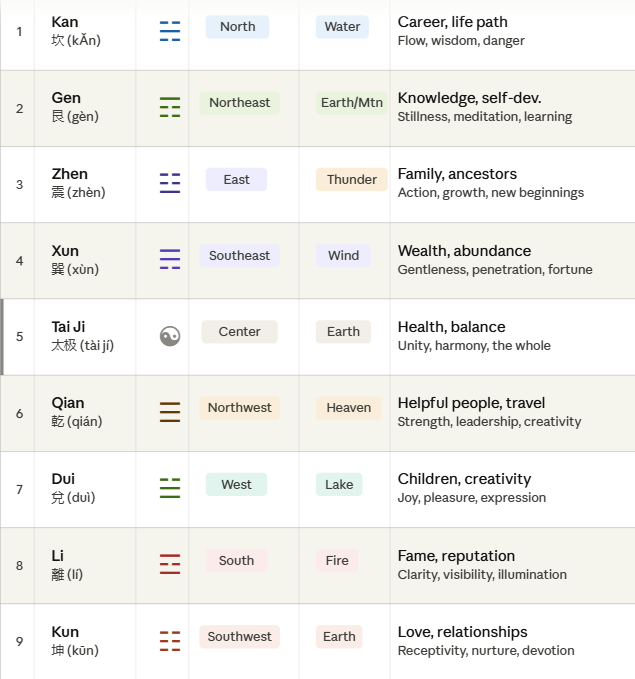
The wedges on the Bagua chart are in the relative positions of the Lo Shu square. The following shows the influences of the Lo Shu numbers and their corresponding trigrams.