Home→Vastu for Small Spaces: Transform Your Home with Ancient Wisdom
Vastu for Small Spaces: Transform Your Home with Ancient Wisdom
Practical tips to align even the tiniest apartment with the five elements — and amplify results with Pyra-Vastu pyramid tools.
Living in a studio apartment, a compact flat, or a tiny house does not mean you have to sacrifice good energy. In fact, Vastu Shastra — the 5,000-year-old Vedic science of spatial arrangement — is remarkably adaptable to modern small living. The core principle is simple: when your space aligns with nature’s five elements (Panchabhuta) and the eight cardinal directions, health, prosperity, and harmony naturally follow — regardless of square footage.
This guide brings you actionable Vastu tips for small spaces, room by room, alongside insights from Pyra-Vastu — a modern science pioneered by Dr. Jiten Bhatt that uses pyramid energy structures to correct Vastu defects where structural changes are impossible.
Many people assume Vastu is only relevant for large bungalows or sprawling villas. This is a myth. The ancient texts of Vastu Vidya were applied to cells in ashrams, market stalls, and single-room dwellings long before the concept of the modern apartment existed. The principles scale — what matters is directional alignment, elemental balance, and energy flow, not the number of rooms.
In a small space, Vastu compliance is actually easier to achieve because one well-placed object, one cleared corner, or one repositioned bed can influence the entire home. Conversely, a single Vastu defect — like a toilet in the northeast zone — has an outsized negative impact in a compact layout. That is why precision matters, and why tools like Pyra-Vastu pyramid instruments have become so popular among apartment dwellers worldwide.
Pyrahealth Insight
Pyra Vastu is the efficient management of pyramid energy to bring about positive awareness and help achieve healthy emotional, mental, spiritual, and physical states of wellness — regardless of the size of your space.
Balancing the Five Elements in a Compact Home
Vastu Shastra is rooted in the harmonious interplay of the five elements: Earth (Prithvi), Water (Jal), Fire (Agni), Air (Vayu), and Space (Akash). In a small home, these elements must be consciously represented because there is limited room for each to naturally settle into its designated zone.
Earth
Prithvi
Represent with ceramic pots, stones, crystals, or terracotta décor. Keep in the Southwest corner for stability.
Water
Jal
A small water feature or aquarium in the Northeast or North zone activates wealth and clarity.
Fire
Agni
Candles, lamps, or an east-facing kitchen stove bring vitality. Avoid fire elements in the North or Northeast.
Air
Vayu
Cross-ventilation through the North and East windows. Keep these areas unblocked for fresh energy circulation.
Space
Akash
Decluttering IS the space element. A clean, open center (Brahmasthan) allows cosmic energy to radiate outward.
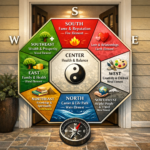
The Eight Directions: What Goes Where
Each of the eight cardinal and intercardinal directions is governed by a specific deity, planet, and life domain. In a small space, you cannot always place every room perfectly — but you can orient key activities and objects toward their ideal direction.
North
Wealth & Career
Keep this zone open and uncluttered. Place your home office desk or locker here. Governed by Kubera.
Northeast
Wisdom & Prayer
Ideal for meditation corner, altar, or prayer space. Water elements are beneficial here. Never place toilets here.
East
Health & Social
Sunlight from the East is sacred. Keep windows open. The main entrance facing East is highly auspicious.
Southeast
Fire & Energy
Kitchen or cooking zone. Electrical equipment fits here. Activates vitality and digestive health.
South
Fame & Protection
Bedroom placement. Keep this zone heavier and closed. Avoid main entrances in the South.
Southwest
Stability & Relationships
Master bedroom and heavy storage. Builds groundedness. Explore relationship corner tips from Pyrahealth.
West
Creativity & Gains
Children’s study area or creative workspace. A dining area in the West promotes shared abundance.
Northwest
Support & Travel
Guest space or bathroom. Represents movement and helpful people. Keep it clean and well-ventilated.
Room-by-Room Vastu Tips for Small Spaces
In a compact home, several “rooms” may exist in the same space. Here is how to optimise each zone individually.
🚪 Entrance & Living Zone
The entrance is the mouth of the home — it sets the energy tone for everything inside. Even in a studio, create a visual threshold: a small doormat, a lamp, or a welcome symbol like Om or Swastika above the door.
Keep the entrance well-lit — dim or broken lights block incoming positive energy.
Avoid placing shoes or clutter directly inside the door.
A North- or East-facing entrance is most auspicious. If yours faces South, a Pyra-Vastu correction can neutralise the defect.
A mirror on the North wall of the living zone activates the wealth direction.
🛏 Bedroom / Sleeping Zone
Sleep direction is critical. In Vastu, the direction your head points while sleeping determines how cosmic energy enters the body during rest.
Best: Head pointing South or East. South gives deep, restorative sleep. East promotes alertness and learning.
Avoid: Head pointing North. This aligns your bio-electromagnetic field against the Earth’s magnetic field, causing disturbed sleep and health issues.
In a studio, use a low bookshelf or curtain to visually separate the sleeping zone from the working zone.
Avoid mirrors directly facing the bed — they double the energy in the bedroom, causing restlessness.
Electronics — especially televisions and routers — should be kept as far from the sleeping zone as possible, or powered down at night.
🍳 Kitchen / Cooking Zone
The kitchen governs health, digestion, and financial well-being in Vastu. Even a galley kitchen in a studio apartment responds to these principles.
Position the stove in the Southeast corner (fire zone) and face East while cooking.
Never place the kitchen directly beneath or opposite a toilet wall — this depletes positive energy.
Keep the sink (water) and stove (fire) separated — they represent conflicting elements. A small plant or wooden cutting board between them acts as a symbolic buffer.
Yellow, orange, or red accents (tiles, curtains, accessories) energise the kitchen.
💼 Home Office / Study Zone
With remote work now mainstream, many small apartments must accommodate a workspace. Vastu offers clear guidance.
Place your desk in the North or East zone, facing North or East while working — both boost concentration and opportunity.
Avoid sitting with your back to the door or window — it creates subconscious insecurity.
Keep the desk clutter-free. A small Pyrahealth pyramid tool on the desk amplifies focus and clears negative thought patterns.
Place certificates, awards, and inspiring images on the South wall of your workspace.
🛁 Bathroom / Toilet Zone
In compact apartments, the bathroom placement is often fixed — but you can still mitigate its Vastu impact.
Always keep the bathroom door closed. Place a Pyron or small pyramid near the bathroom to neutralise draining energy.
Avoid toilets in the Northeast (wisdom zone) — this is the most severe Vastu defect. If yours is here, a Pyra-Vastu correction instrument can help offset the imbalance.
Place a small green plant inside the bathroom to absorb negative moisture energy.
Ensure the exhaust fan works properly — stagnant air here circulates negativity through the home.
Pyra-Vastu: Correcting Vastu Defects Without Renovation
When You Cannot Rebuild — Energise
Renters and small-space dwellers rarely have the luxury of moving walls, relocating kitchens, or repositioning entrances. This is where Pyra-Vastu — the new-age science combining Vedic spatial principles with pyramid energy structures — becomes transformative.
Developed in the 1970s by Dr. Jiten Bhatt and later Dr. Dhara Bhatt, Pyra-Vastu uses physical pyramid instruments placed at strategic grid points within a property to channel and amplify positive cosmic energy, effectively correcting directional defects without structural changes. The principles are documented in Dr. Dhara Bhatt’s book Pyramids for Vastu.
At Pyrahealth, these tools have been refined over decades and are used by Vastu consultants worldwide. Popular solutions for small spaces include:
Pyron Cards9×9 Power PyramidsPyron Pink (relationships)Pyron Grey (children)Pyron MetallicMultier-Max
According to the Pyra-Vastu system, pyramid structures conserve, re-energise, and heal a space by concentrating the cosmic life-force known as prana. This makes them especially effective in small homes where energy is more concentrated and defects have a greater impact.
Cluttered Brahmasthan (center of the home). In Vastu, the center is the most sacred zone — the intersection of all cosmic energies. Piling furniture, storage boxes, or placing a pillar here blocks energy from radiating to every corner. Even in a studio, keep the center as open as possible.
Northeast toilet or kitchen. The Northeast is the zone of wisdom, spirituality, and divine energy. Placing a toilet or heavy stove here is considered the most damaging Vastu defect. If your floor plan has this layout, prioritise a Pyra-Vastu correction immediately.
Sleeping with head to the North. Earth’s magnetic field runs North to South. When your head faces North, like poles repel — resulting in poor sleep, anxiety, and over time, health issues. Simply rotating your sleeping position is one of the easiest and most impactful Vastu fixes.
Dark or blocked entrances. The main door is where prana enters your home. A dark, cluttered, or broken entrance in effect “starves” the home of fresh energy. A bright light and clean threshold make an immediate difference.
Ignoring the Southwest corner. This corner governs stability, relationships, and grounding. In small apartments, it is often used as a dumping zone. Instead, place something heavy here — a bookshelf, a wardrobe, or meaningful objects that anchor the space energetically.
10 Quick Vastu Wins You Can Apply Today
No renovation needed. These practical shifts can transform the energy of your small home immediately.
Declutter your Northeast corner and place a small bowl of water or a crystal there.
Rotate your mattress so your head points South or East tonight.
Place a lamp or bright bulb near your main entrance — even a small LED counts.
Remove broken clocks, dead plants, and non-functional objects — they symbolise stagnation.
Keep bathroom and toilet doors closed at all times to prevent energy drain.
Place a small pyramid tool on your work desk in the North or East corner of your table.
Add a mirror on the North wall of your living or work area to activate the wealth zone.
Open your East-facing windows every morning to invite the rising sun’s energy.
Light a ghee lamp or aromatic candle in the Southeast corner of your kitchen each evening.
Place something heavy — a bookshelf, a potted plant, or a storage unit — in the Southwest corner to create grounding energy.
Pro Tip
For rented apartments where permanent changes are not possible, Pyra-Vastu cards and pyramid instruments are entirely portable, require no drilling, and can be placed discreetly under furniture, inside cabinets, or in window sills to correct directional defects. Learn about the 9×9 Power of Pyramids for maximum energy amplification.
Frequently Asked Questions
Can Vastu really help in a rented apartment where I cannot make changes?
Absolutely. Vastu correction does not require structural renovation. Repositioning furniture, adjusting sleeping direction, strategic use of mirrors and plants, and placing Pyra-Vastu pyramid instruments are all non-invasive corrections that renters can make freely. The Pyra-Vastu system was specifically developed for situations where physical rebuilding is not possible.
What is the most important Vastu rule for a studio apartment?
Keeping the center (Brahmasthan) open and clutter-free is the single most impactful rule. In a studio where all functions coexist, maintaining an unobstructed central zone allows energy to circulate freely to every activity area. The second most important rule is correct sleeping direction — head pointing South or East.
How do I find the directions in my apartment?
Use a reliable compass app on your smartphone, or a traditional compass. Stand at the exact center of your home and note where North lies. Pyrahealth also offers a direction-finding tool on its Pyra-Vastu page. For a full Vastu analysis, consult with a trained Pyra-Vastu expert.
Are there specific Vastu colours for small spaces?
Yes. Lighter colours (whites, creams, soft yellows, pale greens) make small spaces feel more open and aligned with Vastu’s principle of unobstructed energy flow. Zone-specific colours also apply: shades of green or blue in the North, yellow or earthy tones in the Southwest, and warm oranges or reds in the Southeast kitchen area. Avoid dark, heavy colours on all four walls of a small room.
What is the difference between Vastu and Feng Shui?
Both are ancient spatial energy sciences but originate from different traditions. Vastu Shastra is Vedic (Indian), over 5,000 years old, and is rooted in the five elements and eight directions. Feng Shui is Chinese and works with chi (life force), the Bagua energy map, and five Chinese elements. Pyrahealth’s Pyra-Vastu tools have also been found effective by practitioners of both systems, as pyramid energy is universal. You can learn more about the similarities from external resources like Architectural Digest’s comparison guide.
Ready to Transform Your Small Space?
Explore Pyrahealth’s full range of pyramid energy tools designed for apartments, studios, and compact homes — and take your first step toward a harmonised living environment.Browse Pyra-Vastu Products →
SV
Swami Anand Veetrag
A practicing Sanyasi for 45+ years, Swami Anand Veetrag is the founder of Heart & Soul, a meditation and Vastu center operating under the guidance of OSHO International, India. He has served as a healer, meditation center coordinator, and Pyra-Vastu instructor, and is the guiding force behind Pyrahealth.