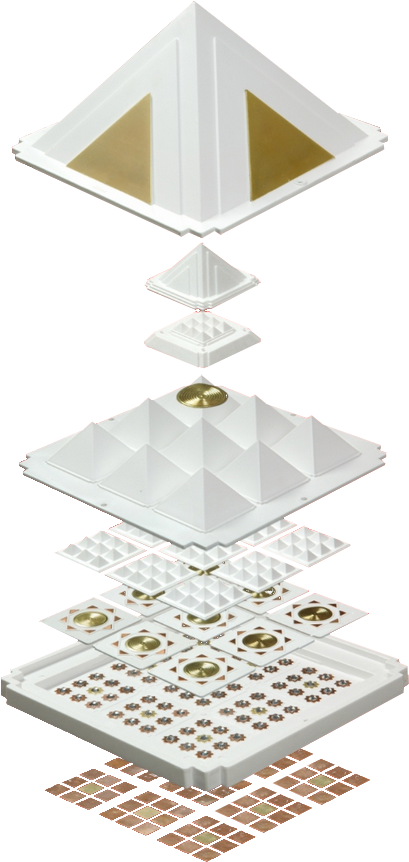
Pyramid Yantra: These remarkable pyramids are carefully designed using sacred symbols, precise geometric shapes, and spiritually significant patterns. Each detail is crafted with purpose, for the pyramid itself is believed to be a powerful conduit of energy capable of harmonizing the mind, body, and spirit. The structure of a pyramid is not only aesthetically appealing but also deeply symbolic; its pointed apex is said to channel cosmic energy downward, while its broad base serves as a foundation that grounds and stabilizes this energy within the user’s environment.
A Pyramid Yantra is organized much like other traditional yantras, each one representing a unique aspect of divine geometry. In spiritual practice, a yantra acts as a tool for meditation and concentration, helping individuals focus their thoughts and elevate their consciousness. When merged with the pyramid’s powerful shape, the yantra’s effects are believed to intensify, allowing practitioners to align their inner energy with the universal flow.
Pyramid Yantra
Different kinds of Pyramid Yantras are created with various intentions. For instance, a Wish Pyramid is specifically designed to assist individuals in manifesting their heartfelt desires and aspirations. It is said that by meditating upon or placing a written wish beneath the pyramid, one can direct positive vibrations toward achieving that particular goal. Some people use it to attract prosperity, improve health, strengthen relationships, or enhance spiritual growth. Others keep it in their home or workplace to maintain a peaceful atmosphere and promote balanced energy throughout the space.
At its essence, the Pyramid Yantra represents something far greater than a mere geometric configuration—it stands as a timeless convergence of art, spirituality, science, and esoteric wisdom. This sacred construct embodies the principle that physical form and spiritual energy are not separate but intrinsically interwoven aspects of the same cosmic design. Acting as a symbolic bridge between the material and the metaphysical realms, the Pyramid Yantra merges the solidarity of matter with the fluidity of divine energy, creating a dynamic field in which consciousness can expand. For countless civilizations—the Egyptians, the Vedic sages, and numerous other ancient cultures—the pyramid shape has been esteemed as a vessel for channeling, amplifying, and stabilizing energy. Its form mirrors the ascending movement of the soul as it strives toward union with the infinite. When the precise geometries of a Yantra—the sacred diagrams representing divine archetypes—are incorporated into the structure of the pyramid, this union gives rise to a multidimensional instrument capable of harmonizing the vibrations of the cosmos with the intricate depths of human consciousness.
Pyramid Yantra Focal Point
From a practical and spiritual standpoint, the Pyramid Yantra serves as an energetic focal point, functioning as an anchor for meditation, energy healing, and inner transformation. Practitioners and meditators often describe a profound shift in awareness when sitting within or near such a structure—reporting sensations of mental clarity, rhythmic breathing, deeper stillness, and a luminous stream of vitality that seems to circulate through both body and mind. The symmetrical precision of the pyramid’s angles is said to create a coherent energy vortex, drawing the universal life force—known in various traditions as prana, chi, or akasha—upward through its apex. This ascending current not only symbolizes the soul’s journey from the dense realm of matter toward higher planes of consciousness, but also illustrates the principle of balance: as energy rises, it is simultaneously redistributed throughout the surrounding field, purifying the atmosphere and harmonizing the inner being of the practitioner. In meditative rites and energy activations, this process has been interpreted as a spiritual alchemy, wherein ordinary awareness is transmuted into enlightened understanding.
As a timeless spiritual instrument, the Pyramid Yantra continues to resonate with seekers across cultures, philosophies, and disciplines. It encapsulates humanity’s everlasting aspiration to connect with the unseen intelligence that pervades the cosmos, serving as both a scientific curiosity and a sacred emblem of transcendence. Within sacred architecture, it is revered as a microcosmic model of the universe, where every line, proportion, and angle symbolizes a stage of consciousness. In personal practice, it can be placed in meditation rooms, healing centers, or sanctuaries as a tool for inner alignment, reminding us to elevate our thoughts, refine our emotions, and rediscover the harmony that exists between self and source. Even in modern metaphysical studies, the Pyramid Yantra stands at the intersection of ancient tradition and contemporary inquiry, uniting intuitive spirituality with the emerging insights of quantum physics and energy science.
Ultimately, the Pyramid Yantra is more than an artifact—it is a living symbol of awakening. It invites us to contemplate not only the mysteries of geometry and the universe but also the hidden architecture of our own consciousness. Through its presence, one perceives that the universe itself is structured according to sacred patterns, and that by attuning ourselves to these universal harmonies, we awaken the luminous potential that resides within every human being. Whether regarded as a meditative focus, a metaphysical symbol, or a key to inner evolution, the Pyramid Yantra endures as a profound testament to humanity’s eternal journey toward enlightenment, bridging the tangible with the transcendental and illuminating the path from form to formlessness, from knowing to being.
Pyramid Yantra is an instrument to achieve a purpose