Home→Lo Shu Square Meaning and Significance in Feng Shui and Ancient Astrology
Lo Shu Square Meaning and Significance in Feng Shui and Ancient Astrology
The Lo Shu square is one of the most significant and ancient symbols found in traditional feng shui philosophy, and it occupies a central place in the study of Chinese metaphysics. This symbol, often referred to as the “magic square,” consists of a nine-chambered 3×3 grid in which the numbers from one to nine are arranged in a perfectly balanced pattern. What makes the Lo Shu square extraordinary is that the sum of the numbers in every row, column, and diagonal is identical—always equaling 15. This constant sum is not arbitrary; it reflects an underlying harmony between the elements and energies that the ancient Chinese believed governed the natural world. Interestingly, the number 15 is also symbolic because it corresponds to the number of days required for the new moon to transform into a full moon, connecting the square to celestial cycles and the concept of balance in nature.
In feng shui practice, each number in the Lo Shu square corresponds to one of the five elements—water, wood, fire, earth, and metal—and is associated with different directions and attributes. For example, specific numbers may be linked to prosperity, career advancement, health, or relationships. By analyzing the arrangement of these numbers and their elemental meanings, feng shui masters seek to harmonize the flow of qi, or life energy, within a home, office, or environment. The Lo Shu square is thus not merely a mathematical curiosity but a symbolic representation of cosmic order and equilibrium, guiding practitioners to achieve stability and success in all areas of life.
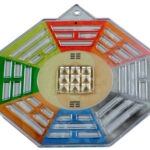
The three-sided-grid pattern is deeply symbolic, representing the intricate relationships reflected in the eight sides of the Bagua symbol. Each of these sides corresponds to one of the eight trigrams in ancient Chinese philosophy, which together form the foundation of the I Ching, or Book of Changes. These trigrams symbolize fundamental natural forces—heaven, earth, fire, water, wind, thunder, mountain, and lake—each embodying specific qualities and energetic movements that influence human life and the environment. The three-sided grid, therefore, becomes much more than a simple geometric design; it is a visual key that represents balance, harmony, and the interconnectivity of all aspects of existence.
Closely tied to this symbolic system is the Lo Shu Square, often referred to as the Magic Square of Feng Shui. In the practice of feng shui, the Lo Shu functions as a powerful tool that adds a temporal dimension to spatial analysis. While the Bagua reveals the spatial and elemental interactions within a space, the Lo Shu brings in the element of time, enabling practitioners to interpret how energies shift and transform in different periods.
By integrating the information from both systems, a feng shui expert can determine not only which areas of a home or building are in need of adjustment but also when those modifications will have the greatest positive impact. This timing aspect is fundamental to advanced feng shui practice, often guiding decisions about when to begin renovations, rearrange furniture, add certain colors or materials, or place symbolic objects to optimize energy flow. In essence, the Lo Shu unveils the rhythm of cyclical change, allowing individuals to align their environments with the natural patterns of time and energy. When used with mindfulness and respect for its ancient origins, this combination of the Bagua and the Lo Shu becomes a profound framework for cultivating harmony, prosperity, and personal well-being in every aspect of life.
Chinese tradition says that the first image of the Lo Shu square was seen by Sage Yu. He saw this mystical arrangement of numbers as white spots which were arranged in this particular pattern on the nine-grid shell off a tortoise which emerged from the rive Lo in 2205 BC. The ancient Indian system of astrology and yantra technique has created yantra squares. These planetary squares were used to generate signs that control the spirit of planets. The square of Saturn or “Shani” has the exact same arrangement of numbers as the Lo Shu square. Since then, the Lo Shu square has been revered not only as a tool for divination and feng shui interpretation but also as a profound symbol of wisdom, cosmic balance, and the cyclical rhythms of nature that influence all living things.
As dots on a tortoise are awkward to use, for practical use the Lo Shu square is used as a 9 chambered 3×3 grid with numbers in each chamber.