Table of Contents
According to Vastu Shastra, the ancient Indian science of architecture and spatial harmony, the roads and intersections leading to a home play a vital role in determining the flow of positive and negative energies around a property. The direction, angle, and positioning of the roads surrounding a house can influence the well-being, prosperity, and peace of its occupants. For instance, a home located on a plot that faces the cardinal directions—north, east, south, or west—interacts differently with the energies created by nearby roads and pathways.
In Vastu, the incoming and outgoing movement on roads is symbolic of both opportunities and challenges in life. A clean, well-aligned road facing the entrance of a home can enhance the flow of positive vibrations, abundance, and harmony. Conversely, a poorly aligned or intersecting road directly meeting the front of a house may disturb energetic balance and bring instability or obstacles. The type of intersection—such as a T-junction, Y-junction, or crossroad—is also carefully analyzed in Vastu assessments, as each configuration carries distinct energy patterns that affect the health and fortune of residents.
Furthermore, Vastu experts recommend ensuring that the road level is slightly lower than the plot to allow energy and prosperity to flow inward. Roads from the east or north are usually considered auspicious because they bring divine energy associated with the rising sun and magnetic orientation, while roads from the south or west may require specific remedies to neutralize heavier or more stagnant forces.
Thus, roads and intersections are not merely physical access points but energetic pathways that connect a home with its surroundings. Thoughtful planning in accordance with Vastu principles helps ensure that a house becomes a harmonious space, attracting success, happiness, and long-term stability for its inhabitants.
Vastu Rules for Roads and Intersections to a House
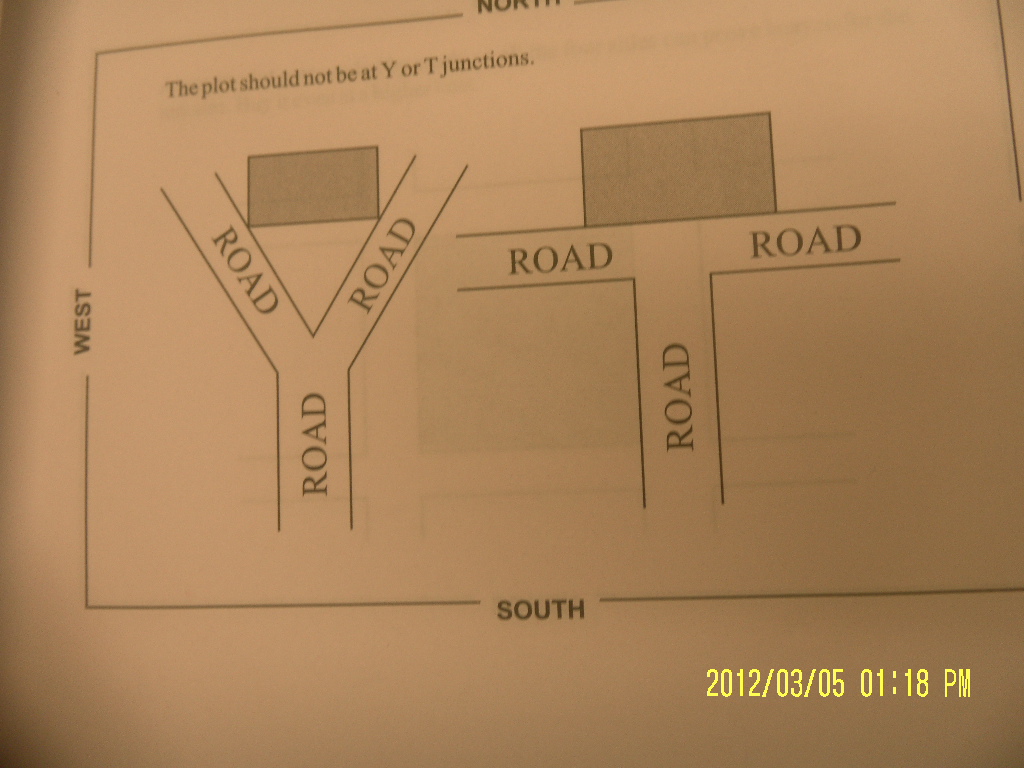
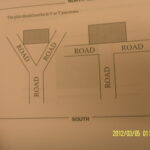
- The house should not be at a Y or a T intersection.
- It is generally advised that a resudebce should not be located at a Y-shaped or T-shaped intersection. Such intersections are considered inauspicious because they allow direct flow of energy, light, and external forces toward the property, which can disturb the balance and tranquility of the household. In Vastu philosophy, the continuous and unrestrained movement of energy—especially when it directly strikes the main entrance or façade of a building—is believed to cause instability, financial strain, or health-related challenges for the occupants.
- When a dwelling is positioned at a T-junction, for instance, the road coming straight toward the building is said to bring aggressive or negative energy, symbolizing pressure and obstacles entering one’s personal space. Similarly, in the case of a Y-intersection, the split in the road can create a divergence of energy, leading to confusion, fragmentation, or lack of focus in the lives of residents. This is why Vastu experts recommend selecting plots that are surrounded by roads on more even or symmetrical sides rather than facing the direct path of incoming traffic or energy flow.
- However, modern Vastu consultants often suggest remedial measures if one already owns or plans to buy such a property. Remedies can include creating a well-designed boundary wall, adjusting the entrance position, installing protective elements such as Vastu pyramids or plants, or using reflective surfaces to divert the excess energy. With thoughtful architectural planning and mindful placement of entrances and rooms, it is sometimes possible to minimize the negative effects associated with a Y or T intersection while still maintaining aesthetic and structural harmony.
- In short, Vastu Shastra emphasizes balance, orientation, and energy flow as key determinants of prosperity and well-being, and avoiding a building at a Y or T intersection is one of the traditional ways to ensure that the natural and built environment remain harmoniously aligned.
- If a road ends at your house from the Northeastern corner it is considered very good.
- If your lot has roads on the Eastern and Northern sides it is also good.
- If you are a business man, a road on the Western or Southern side of your home can also be good, depending upon other factors.
- A yard surrounded by three side roads on East, West and South is not considered good.
- Southern side road is not considered to be very good.
- Northern side road is good.
- A road on the Western side is reasonable.
- If there is only one road on the Eastern side of the yard it is good.
- If roads are on the Northern and Western sides of your yard, it is OK.
- As already stated, neither the ground nor the building should be higher in the Northeast. The ground should have a slope in the Northeast and the walls of the building should also be lower in the Northeast and the walls of the building should be lower in the Northeast than Southwest. If possible, the walls in the Northeast should be thinner than walls of the Southwest.
- If your yard is not towards any of the four directions and the road is also going straight, you should plan your house not parallel to the road which it abounds but it should be located according to the magnetic South and North line to make it in full calibration with the four directions.
- A road ending to the house is very bad. Never buy a lot in which the road comes in like a dagger, provided it is not coming fro the Northeast direction.
- If your lot has roads on the Eastern and Northern sides it is also good.
- If you are a business man, a road on the Western or Southern side of your yard can also be good, depending upon other factors.
- Property surrounded by three side roads on the East, West and North is not considered good.
- Roads in the North, West and South of a house are not good.
- A lot surrounded by three side roads on the East, West and South is not considered good.
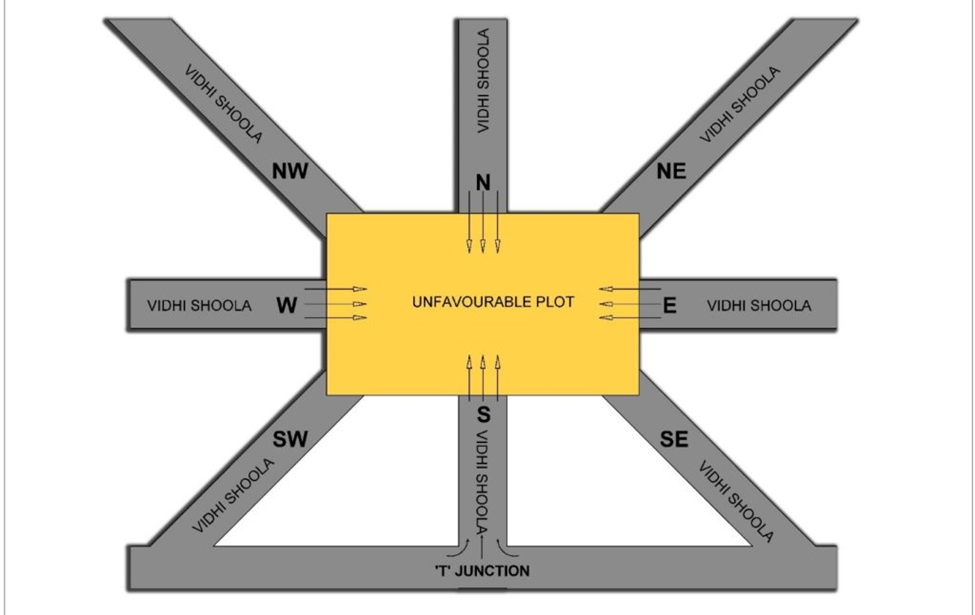
Benefits of Proper Road Placement in Vastu
Following the right principles for roads and intersections to a property can bring long-term benefits. Proper road alignment supports smooth energy flow, which is believed to enhance financial stability, health, and mental peace. Properties with favorable road directions often experience better growth opportunities and overall positivity.
When roads are aligned correctly, it helps in maintaining harmony between the surrounding environment and the living space. This balance reduces stress, improves decision-making, and supports a more stable lifestyle. Many Vastu experts emphasize road placement as one of the key factors in selecting a property.
Mistakes to Avoid
- Choosing plots where roads directly hit the main entrance
- Ignoring the importance of Northeast openness
- Constructing heavy structures near road-facing directions
- Not checking road slope and alignment before purchase
By avoiding these common mistakes, you can ensure that the roads and intersections to a property support positive energy rather than creating imbalance.
Also look for Importance of Roads in Vaastu.
Look up the description and benefits in Pyramid Yantra for Vaastu Book on Page 104
For a deeper understanding of Vastu principles related to roads and property placement, you can refer to trusted resources like Vastu Shastra