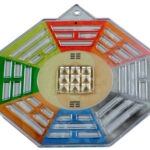
The Bagua trigrams form a central concept in Taoist philosophy, symbolizing the fundamental structure of reality, which is believed to consist of eight dynamic and interrelated elements. Each Bagua trigram is composed of three lines that are either broken or unbroken, representing the dual principles of yin and yang—the complementary forces that govern the balance and transformation of all things in the universe. Yin symbolizes qualities such as receptivity, darkness, and stillness, while yang embodies activity, brightness, and creativity. Together, they express the Taoist understanding that life is sustained by the harmonious interplay of opposites, and that every phenomenon arises from their continuous movement and interaction.
According to this worldview, the universe is never static but is always in a state of transformation. The eight trigrams, known as Bagua, mirror this ceaseless change through their numerous patterns and relationships. Each trigram possesses its own symbolic meaning and association with natural elements and phenomena—such as heaven, earth, thunder, wind, water, fire, mountain, and lake. These symbols not only represent physical aspects of nature but also psychological and spiritual qualities, illustrating the holistic vision of Taoist cosmology. The combinations of these trigrams reveal the countless ways yin and yang can merge and shift, producing both harmony and contrast, stability and transformation.
When two Bagua trigrams are combined, they form a set of sixty-four possible configurations known as hexagrams. These hexagrams form the foundation of the I Ching—also called the Book of Changes—one of the most revered texts in Chinese philosophy and divination. The I Ching uses these hexagrams as a means of interpreting the patterns of change that occur in both nature and human life, providing wisdom for decision-making and self-reflection. In later Taoist and Feng Shui practices, the Bagua trigrams became essential tools for understanding spatial energy, helping practitioners align their environments with the natural flow of the universe. Through the study and application of the Bagua trigrams, one can gain deeper insight into the rhythm of existence, the balance of opposites, and the universal principle of transformation that links all things.
Bagua Trigrams Summary Table
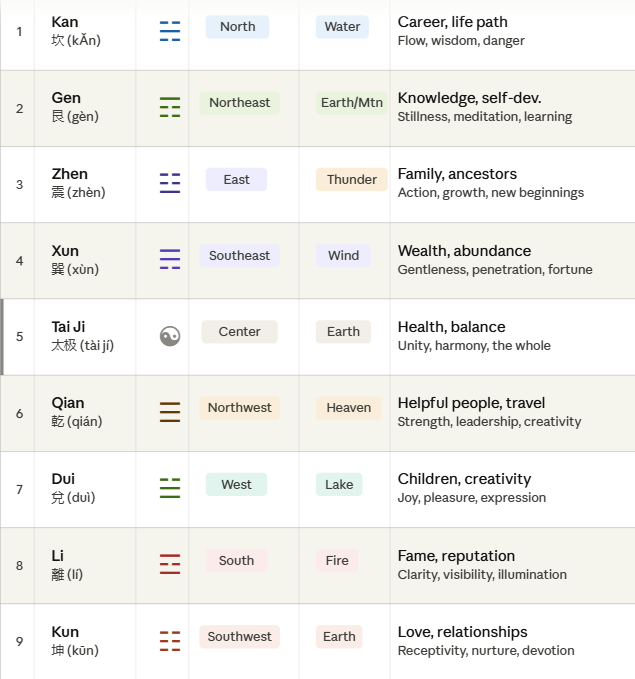
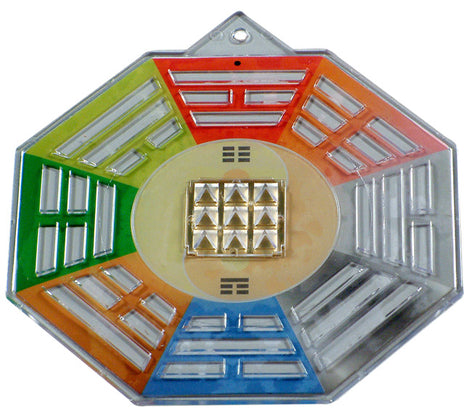
Each Bagua trigram is made up of three lines. The line can be broken or unbroken. Broken lines are yin and unbroken lines are yang. These eight Bagua trigrams reflect the gradual movement from absolute yin to absolute yang and back to absolute yin in a never-ending cycle.
- ☵ Kan represents career, business, success, and our journey through life. It is associated with winter, its element is water and direction is North. Its number is 1.
- ☷ Kun represents union, relationships, domesticity and maternal instincts, good spouse, partnership, peace and happiness. It is associated with summer, its element is earth and direction is southwest. Its number is 2.
- ☳ Chen represents health, vitality, elders, growth, ancestors, family, wisdom and experience. It is associated with early spring and new beginnings. Its element is wood and direction is East. Its number is 3.
- ☱ Sun represents wealth, blessings, growth, gentleness, assimilation and fortune. It is associated with wind and early fall. Its element is wood and direction is Southeast. Its number is 4.
- ☯ The yin-yang symbol represents unity and a balance of positive and negative chi. Its number is 5.
- ☰ Chien represents leadership, achievement, helpful friends, mentors, teachers, travel, improvement and new beginnings. It is associated with summer, its element is strong metal and direction is Northwest. Its number is 6.
- ☴ Tui represents creativity, joy, children and projects. It is associated with autumn, its element is little metal and direction is West. Its number is 7.
- ☶ Ken represents knowledge, wisdom, intuition, contemplation and motivation. It is associated with early winter, its element is earth and direction is Northeast. Its number is 8.
- ☲ Li represents illumination of self, reputation visibility, fame, fortune and prosperity. It is associated with summer, its element is fire and direction is South. Its number is 9.
The Pyron RED-FAME module presents the Li trigram with the fire element’s red color and its Lo Shu number 9.